Jizoin Temple, also known as “Tsubaki-dera” (Camellia Temple), is a Jodo sect Buddhist temple located in Kita Ward, Kyoto. Founded in 726 by the monk Gyoki, it boasts a long and distinguished history.
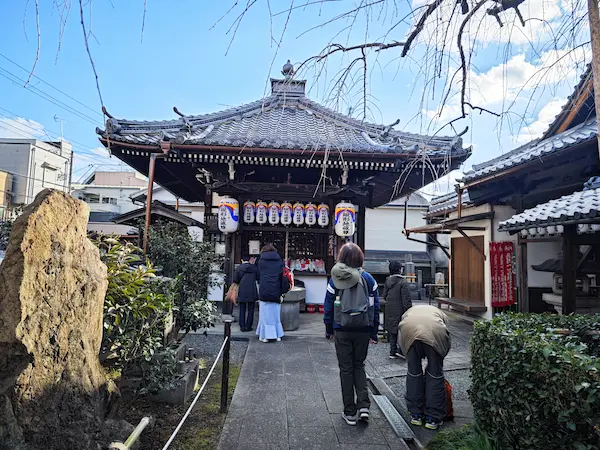
The temple’s most notable feature is the “Goshiki Yae Chiri Tsubaki” (Five-colored Double-petaled Scattered Camellia) in its grounds. This camellia is said to have been donated by Toyotomi Hideyoshi during the Kitano Grand Tea Ceremony. The current tree is the second generation, about 200 years old with a trunk circumference of about 50 centimeters. It’s best viewed from mid-March to early April, known for its beautiful scattering petals.
Cultural assets of Jizoin Temple
The main hall houses the principal Buddha, a statue of Amida Nyorai in the Gokoshiyui style, created during the Edo period. This statue is characterized by its large hairstyle with extended spiral curls. Amitabha Buddha’s hair is long, indicating that he was unable to care for his hair due to his ascetic practices.

In the Kannon Hall, there is a single-block wooden statue of the Eleven-Faced Kannon, said to be the work of Jikaku Daishi Ennin. This statue is flanked by Uho Doji and Kasuga Ryujin, making it the 30th temple of the Rakuyo 33 Kannon Pilgrimage.
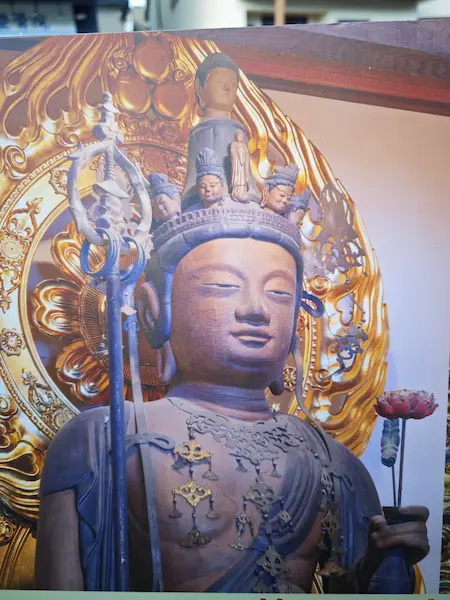
The Jizo Hall enshrines a statue of Jizo Bodhisattva, which was formerly the principal Buddha. Also known as “Kuwakata Jizo,” it is said to have been created by Gyoki. An interesting legend surrounds this Jizo statue.
Jizoin Temple has connections with several historical figures. Ashikaga Yoshimitsu rebuilt it using leftover materials from Kinkaku-ji, and Toyotomi Hideyoshi moved it to its current location. The temple has also inspired cultural figures such as the haiku poet Masaoka Shiki, who wrote about its camellias, and the painter Hayami Gyoshu, who created a folding screen painting titled “Meiju Chiri Tsubaki”.
In the precincts of the temple is the grave of Amanoya Rihei, who is known as a wealthy merchant who helped the Ako Roshi. This man is known as a wealthy merchant who helped the Ako Roshi. However, there is a theory that this is a later fiction.
Access
The temple is easily accessible, just a few minutes’ walk from the “Kitano-hakubaicho” station on the city bus or Keifuku Electric Railroad. Visiting hours are from 9 AM to 4 PM, and admission is free.
However, cultural assets such as Buddhist statues are usually closed to the public.
Nearby spots from Jizoin Temple
Along Ichijo-dori, where Jizoin is located, there is the Taishogun Hachi-jinja Shrine.
The famous Kitano Tenmangu Shrine is also a short walk away.
If you prefer a place without many tourists, how about Daruma Temple?
Related articles:
[…] Jizoin Temple, with its rare camellia tree, is a short walk away. The unique Amida Nyorai statue at this temple is usually closed to the public. […]
[…] Jizoin Temple is famous for its rare camellia tree and unique Amida Buddha statue. […]